
Earthquake-Resistant Home Construction in Dehradun: Building for High Seismic Risk Areas
Table of Contents
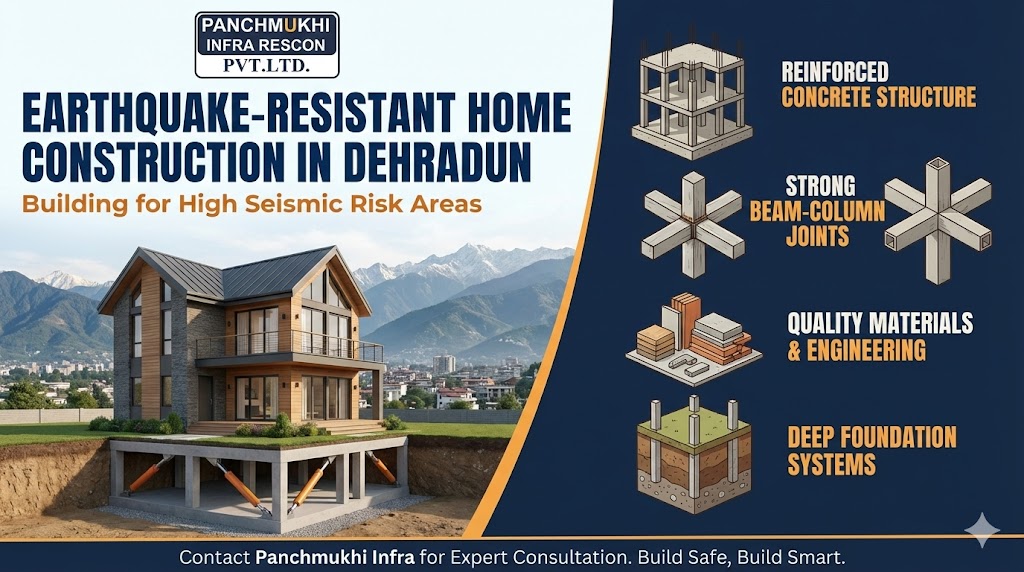
Dehradun has emerged as one of Uttarakhand’s most preferred residential cities, with rapid development across areas like Sahastradhara Road, Rajpur Road, Canal Road, GMS Road, Prem Nagar, and Dalanwala.
However, this growth comes with a serious responsibility—building homes that are structurally safe in a high seismic risk region.
Traditionally, Dehradun has been classified under Seismic Zone IV. However, it lies very close to Seismic Zone V regions, and recent assessments by disaster management authorities (as of late 2025) indicate that the entire Himalayan belt faces extremely high earthquake vulnerability.
This makes earthquake-resistant home construction in Dehradun essential—especially in fast-growing residential corridors like Sahastradhara Road and Rajpur Road, where multi-storey homes and villas are increasingly common.
Why Local Seismic Risk in Dehradun Cannot Be Ignored
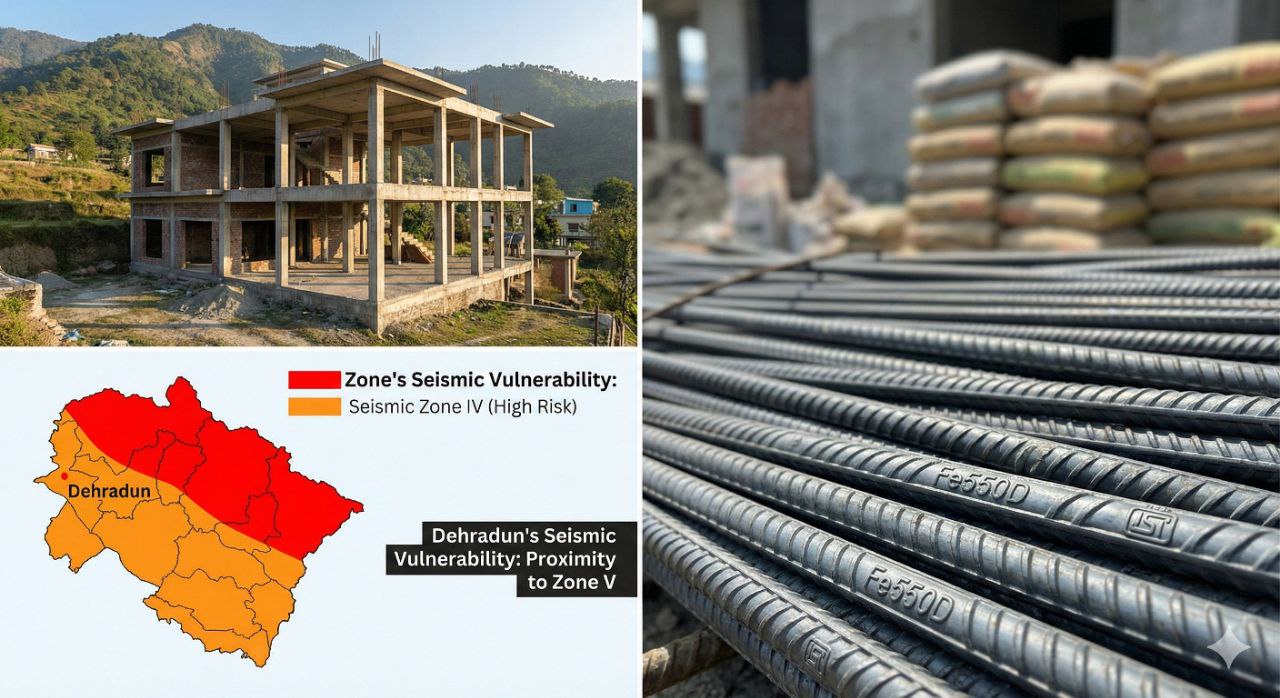
The Himalayan region is tectonically active due to the collision of the Indian and Eurasian plates. Areas such as Sahastradhara Road, IT Park Road, and Maldevta Road are particularly sensitive due to terrain, soil variation, and proximity to fault lines.
Homes built without proper seismic detailing may appear strong but can develop deep structural cracks even during moderate tremors—making repairs expensive and unsafe.
Why Earthquake-Resistant Homes Are a Must in Areas Like Sahastradhara & Rajpur Road
Modern residential zones in Dehradun often feature:
- Independent villas
- G+2 and G+3 homes
- Rental floors and duplexes
In high-demand localities like Rajpur Road and Sahastradhara Road, property value is high—making structural failure a massive financial and safety risk.
Earthquake-resistant construction helps:
- Prevent partial or total collapse
- Protect families and occupants
- Increase long-term durability
Improve resale and rental value
Core Engineering Principles of Earthquake-Resistant Construction
Professional civil contractors in Dehradun follow a science-backed approach, not shortcuts.
- Soil Testing & Foundation Design
Different areas like Canal Road and Sahastradhara Road have varying soil bearing capacities. Soil testing ensures foundations are designed to safely transfer seismic loads.
- RCC Framed Structure (As per IS Codes)
A properly designed RCC (Reinforced Cement Concrete) structure allows controlled movement during earthquakes instead of sudden failure.
- Use of Certified Construction Materials
Using BIS-approved materials is a major trust signal for both safety and SEO.
Commonly used materials include:
- Fe550D TMT steel bars (high ductility for seismic zones)
- M25 / M30 grade concrete for structural elements
- IS 456 & IS 13920 compliant detailing
- IS 875 load calculations
These materials significantly improve earthquake performance.
- Strong Beam–Column Junctions
Proper reinforcement detailing at joints prevents “soft-storey collapse,” a common failure in non-engineered homes.
- Structural Symmetry & Load Balance
Homes with balanced layouts (common in planned areas like GMS Road and Dalanwala) perform far better during seismic events.
MDDA Approval & Structural Safety in Dehradun
Any safe construction project must start with legal and structural approvals.
A professional construction company in Dehradun handles:
- House map approval
- MDDA approval
- Structural drawings approved by licensed engineers
This is especially important in premium localities like Rajpur Road, where regulatory scrutiny is higher.
Earthquake + Monsoon: Dehradun’s Dual Risk Factor
Dehradun receives heavy rainfall, which weakens soil and foundations if not treated properly.
Modern earthquake-resistant homes must include:
- Plinth-level damp-proofing
- Foundation waterproofing
- Proper stormwater drainage
- Anti-corrosion steel protection
Ignoring monsoon-proofing can reduce seismic safety over time.
Panchmukhi Infra Rescon Pvt. Ltd.: Building Safer Homes Across Dehradun
Panchmukhi Infra Rescon Pvt. Ltd. is a trusted name in earthquake-resistant home construction in Dehradun, with experience across key residential areas such as Sahastradhara Road, Rajpur Road, Canal Road, and surrounding localities.
Our construction approach focuses on:
- Seismic-resilient RCC structures
- Use of Fe550D steel & high-grade concrete
- MDDA-approved planning and execution
- Monsoon-proof construction methods
We build homes designed to withstand both seismic activity and local climate conditions.
How to Choose the Right Residential Builder in High-Risk Zones
When constructing in earthquake-prone areas, always choose builders who:
- Follow BIS & IS seismic codes
- Use certified materials
- Understand Dehradun’s soil & climate
- Provide transparent structural planning
Experienced residential builders in Dehradun don’t just build homes—they build safety.
Conclusion
With rapid development in areas like Sahastradhara Road and Rajpur Road, Dehradun homeowners must prioritise structural safety over short-term cost savings.
Earthquake-resistant construction is no longer optional—it is the foundation of responsible urban living in the Himalayan region.
Planning to Build a Safe Home in Dehradun?
Protect your family and your investment with scientifically engineered, earthquake-resistant construction.
📞 Get a FREE Construction Consultation & Cost Estimate today
📩 Contact Panchmukhi Infra Rescon Pvt. Ltd. for MDDA-approved, seismic-safe home construction in Dehradun.
🏗️ Built for safety. Engineered for strength. Designed for the future.
Frequently Asked Questions (FAQs)
1. Does earthquake-resistant construction increase the house construction cost in Dehradun?
Many homeowners fear high costs, but making a home earthquake-resistant typically adds only 10% to 15% to the total budget. This small investment covers high-grade steel (Fe550D) and deeper foundations, which saves you from 100% loss during a disaster and significantly lowers long-term maintenance costs.
2. Is soil testing mandatory for building a house in Dehradun
Yes. Dehradun has diverse soil types, from the rocky terrain of Rajpur to the clay-rich soil near the rivers. A professional construction company always performs a Geotechnical Investigation (Soil Test) to determine the “bearing capacity” of the land. Without this, even a strong building can sink or tilt during an earthquake (liquefaction).
3. Can an existing old house in Dehradun be made earthquake-proof?
Yes, this process is called Retrofitting. It involves adding new shear walls, jacketing columns, and strengthening foundations without demolishing the house. We recommend getting a structural audit from experienced civil contractors in Dehradun to check your home’s vulnerability before starting renovations.
4. Why is MDDA approval critical for earthquake safety? The
The Mussoorie Dehradun Development Authority (MDDA) has strict bylaws that align with the National Building Code (NBC) for seismic safety. Getting MDDA approval ensures your structural drawings meet these safety standards. It is also mandatory for processing home loans and ensures legal safety during resale.
5. Why should I hire a professional builder instead of a local mason (thekedar)?
While local labor is essential, earthquake-resistant construction requires engineering precision that traditional masons may lack. A professional turnkey construction company ensures that critical technical details—like proper stirrup spacing in columns and correct concrete mixing ratios (M25/M30)—are supervised by qualified site engineers, not just left to guesswork.
Contact Us | Book Your Project
Earthquake-Resistant Home Constructionin Dehradun: Building for High SeismicRisk Areas
Earthquake-Resistant Home Construction in Dehradun: Building for High Seismic Risk Areas Table of Contents Dehradun has