
How to Choose the Right Plot Size for Building a House in Dehradun
Table of Contents
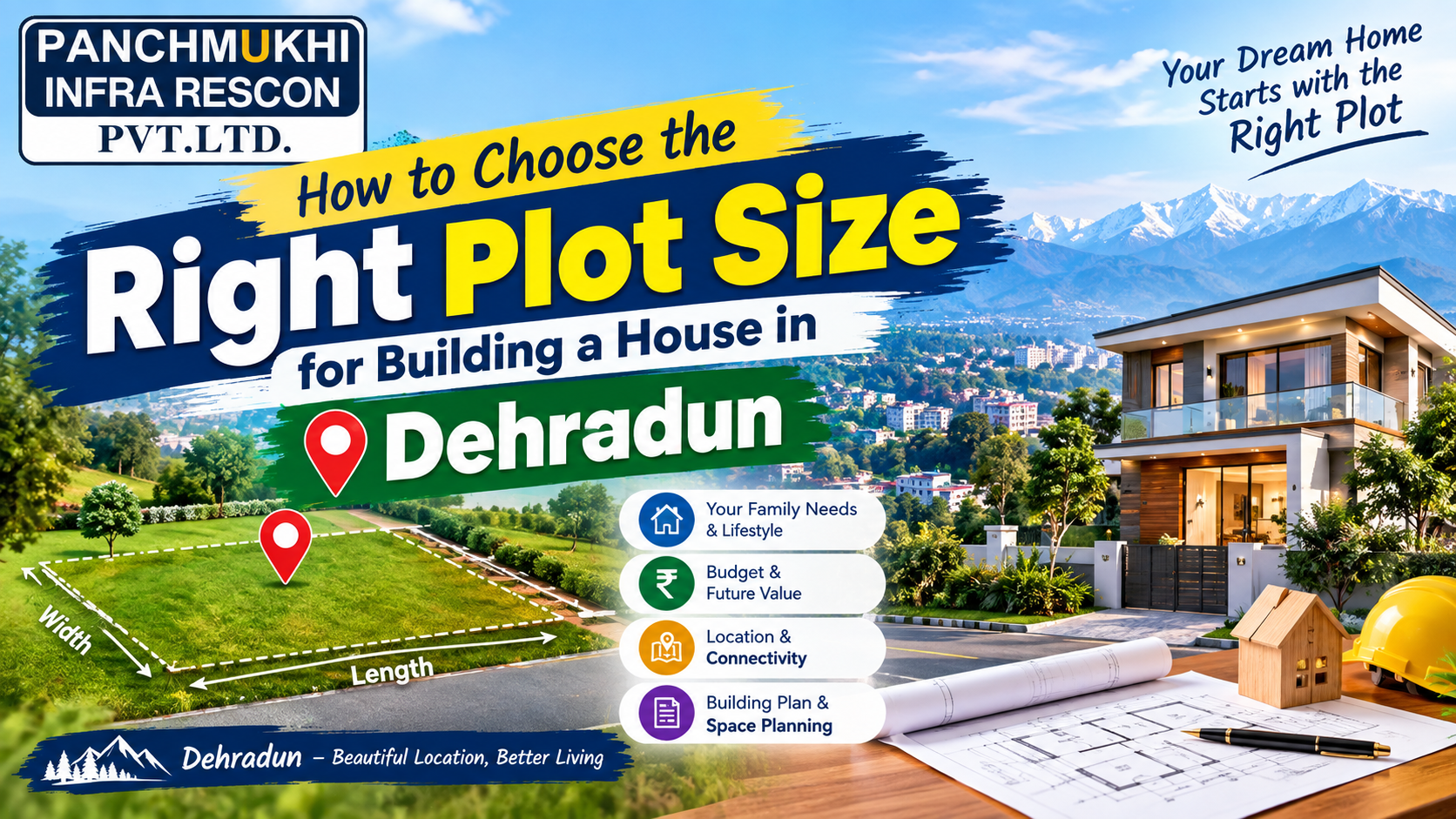
Before you finalize an architect, a contractor, or even a design mood board, there’s one decision that quietly shapes everything else about your home: the plot size. Choosing the right plot size for building a house isn’t just about how much land you can afford — it determines your house’s layout, natural light, parking space, garden area, and even its resale value years down the line.
In a city like Dehradun, where the terrain ranges from flat valley land to gentle hill slopes, plot size decisions carry extra weight. A plot that works perfectly in Rajpur Road may feel cramped in a denser locality like Patel Nagar. At Panchmukhi Infra Rescon Pvt Ltd, we’ve guided countless families through this exact decision, and this guide distills that experience into a practical framework you can use today.
Factors to Consider Before Choosing a Plot Size
Getting the right plot size for building a house starts with an honest look at your needs, not just what’s available in the market.
Family Size and Lifestyle
A couple planning a compact 2BHK has very different space needs than a joint family expecting three generations under one roof. Think about bedrooms, a home office, a puja room, or even a small lawn for your kids or pets — all of this feeds directly into the plot size you should target.
Construction Budget
Plot size and construction cost move together. A bigger plot means a bigger boundary wall, more flooring, extended plumbing and electrical runs, and higher landscaping costs — even before you calculate the built-up area. It’s wise to map your total budget across land cost, construction cost, and finishing costs before shortlisting a size.
Future Expansion Plans
Many homeowners in Dehradun choose a plot slightly larger than their current need, keeping room for a future floor or an extended family wing. If expansion is even a remote possibility, factor it in now — retrofitting later is always costlier.
Location and Accessibility
A plot’s usable size also depends on its location. Corner plots, plots on narrow lanes, or those with irregular shapes may need extra setback space, effectively reducing your buildable area. Always evaluate accessibility, road width, and neighborhood zoning before locking in a size.
Common Plot Sizes for Residential Houses in Dehradun
Dehradun’s residential colonies commonly feature a handful of standard plot sizes. Here’s how they typically compare:
| Plot Size | Total Area (sq. ft.) | Ideal For | Typical Built-Up Area* |
|---|---|---|---|
| 30 × 40 Feet | 1,200 sq. ft. | Nuclear families, budget builds | 900–950 sq. ft. per floor |
| 30 × 50 Feet | 1,500 sq. ft. | Small-to-mid families | 1,150–1,200 sq. ft. per floor |
| 40 × 50 Feet | 2,000 sq. ft. | Mid-size families, home office | 1,550–1,650 sq. ft. per floor |
| 40 × 60 Feet | 2,400 sq. ft. | Joint families, larger homes | 1,900–2,000 sq. ft. per floor |
*Built-up area estimates assume standard setbacks as per typical MDDA byelaws; actual figures vary by locality and floor count.
30 × 40 Feet Plot
This is one of the most popular entry-level plot sizes for a single-family home with 2–3 bedrooms, a living area, and basic parking.
30 × 50 Feet Plot
A slightly elongated option that adds a bit more room for a garden strip or an additional utility area without dramatically increasing cost.
40 × 50 Feet Plot
This size comfortably supports a 3BHK layout with a dedicated dining space and better cross-ventilation.
40 × 60 Feet Plot
A generous footprint well-suited to duplex designs, larger driveways, or homes that need to accommodate elderly parents and children together.
How Much House Can You Build on Your Plot?
Your plot size doesn’t equal your buildable area. Local development authority norms — including setback rules and Floor Area Ratio (FAR) — determine how much of the plot you can actually construct on. For instance, a 40 × 60 feet plot with standard setbacks might yield a ground coverage of roughly 65–70%, meaning your actual footprint per floor could be smaller than expected. Before finalizing your plot size, always check current byelaws with the Mussoorie Dehradun Development Authority (MDDA) to understand permissible coverage and height restrictions for your zone.
Understanding Setbacks and Open Space Requirements
Setbacks are the mandatory open spaces left on all sides of a plot — front, rear, and sides — before construction begins. These aren’t optional; they ensure proper ventilation, fire safety access, and light penetration. Smaller plots (like 30 × 40 feet) often have proportionally larger setback percentages relative to total area, which is why choosing the right plot size for building a house also means understanding how much of it you’ll actually get to build on. Skipping this step is one of the most common planning mistakes among first-time homeowners.
Plot Size vs. House Built-Up Area
| Plot Size | Ground Coverage (Approx.) | Effective Built-Up Area (Ground Floor) |
|---|---|---|
| 30 × 40 Feet | 70–75% | 850–900 sq. ft. |
| 30 × 50 Feet | 72–75% | 1,100–1,150 sq. ft. |
| 40 × 50 Feet | 75–78% | 1,550–1,600 sq. ft. |
| 40 × 60 Feet | 75–80% | 1,850–1,950 sq. ft. |
This gap between plot size and usable built-up area is exactly why working with an experienced team matters. Our residential construction services help homeowners map exact buildable dimensions before a single brick is laid.
Best Plot Size for a Joint or Large Family
Joint families or those planning multi-generational living should look at 40 × 50 feet or 40 × 60 feet plots. These sizes accommodate independent floors, separate entrances, larger common areas, and enough parking for multiple vehicles — all essential when several family units share one property.
Choosing a Plot Size Based on Your Budget
| Budget Range (Land + Construction) | Recommended Plot Size | Notes |
|---|---|---|
| Under ₹40 Lakhs | 30 × 40 Feet | Focus on essential rooms, minimal ornamentation |
| ₹40–70 Lakhs | 30 × 50 or 40 × 50 Feet | Room for a home office or guest room |
| ₹70 Lakhs – ₹1.2 Crore | 40 × 50 or 40 × 60 Feet | Duplex options, premium finishes |
| Above ₹1.2 Crore | 40 × 60 Feet and above | Custom layouts, landscaping, larger driveways |
These figures are indicative and will shift with material costs, locality, and finishing quality — our team can help you build a realistic budget breakdown specific to your chosen plot size.
Importance of Plot Shape, Road Width and Direction
A rectangular plot generally offers more design flexibility than an irregular or triangular one of the same square footage. Road width in front of your plot also affects both construction permissions and daily convenience — narrower lanes can restrict vehicle access during construction and limit future FAR benefits. Direction matters too: east or north-facing plots are traditionally preferred in Dehradun for better natural light and ventilation, and often command a slightly higher resale value.
Locality-Wise Plot Size Considerations in Dehradun
Different pockets of Dehradun favor different plot sizes based on density and terrain:
- Rajpur Road & Vasant Vihar: Larger plots (40 × 60 feet and above) are common, given the area’s upscale, spacious layouts.
- Patel Nagar & Dharampur: Compact plots (30 × 40 feet) dominate due to higher density and narrower lanes.
- Sahastradhara Road & Miyanwala: Mid-to-large plots are popular among buyers seeking a quieter, semi-urban setting.
- Clement Town & Premnagar: A mix of sizes, often favored by families relocating from within the city for more affordable land.
Always cross-check zoning classifications for your chosen locality through the Uttarakhand RERA portal before finalizing a purchase.
Mistakes to Avoid When Buying a Residential Plot
- Ignoring setback and FAR rules, then discovering the buildable area is far smaller than expected.
- Skipping a soil test, especially in Dehradun’s varied terrain where foundation costs can vary significantly.
- Overlooking road width and access, which can complicate both construction logistics and future resale.
- Not verifying land titles and approvals, leading to legal disputes later.
- Choosing size based on price alone, without considering long-term livability and expansion needs.
Checklist Before Purchasing a Plot in Dehradun
- Confirm land title, mutation records, and encumbrance certificate.
- Verify MDDA/local authority approval and zoning classification.
- Check road width, direction, and neighborhood infrastructure.
- Assess soil condition and drainage.
- Calculate actual buildable area after setbacks.
- Match plot size to your family size, budget, and future plans.
- Consult a professional team, such as Panchmukhi Infra Rescon, before signing any agreement.
Conclusion: Choosing the Right Plot for Your Future Home
Choosing the right plot size for building a house in Dehradun is ultimately about balancing your family’s current needs with future flexibility, all within a realistic budget. Whether you’re drawn to a compact 30 × 40 feet plot or a spacious 40 × 60 feet layout, the goal is the same: a home that fits your life comfortably, today and years from now.
If you’re still weighing your options, the team at Panchmukhi Infra Rescon Pvt Ltd can help you evaluate plot sizes, understand local building norms, and plan a construction budget that matches your vision. Get in touch with our team to start planning your dream home in Dehradun today.
Frequently Asked Questions About Plot Sizes in Dehradun
The 30 × 40 feet and 40 × 50 feet plots are among the most commonly chosen sizes for residential homes in Dehradun, balancing affordability with livable space.
Start with your family size, add future expansion needs, factor in your budget, and then check local setback and FAR rules to see how much of that plot you can actually build on.
Not necessarily. While land cost is lower, cost per square foot for construction can sometimes be higher on smaller plots due to fixed costs like boundary walls and utility connections being spread over less built-up area.
Yes. Depending on plot size and local byelaws, setbacks can reduce your buildable footprint by 20–30%, which is why understanding this before purchase is critical.
Absolutely. A professional assessment can flag issues like poor soil quality, restrictive setbacks, or zoning limitations before you commit financially.
Contact Us | Book Your Project

How to Choose the Right Plot Size for Building a House in Dehradun
How to Choose the Right Plot Size for Building a House in Dehradun Table of Contents